|
Here are short letters that you can easily print and mail. Select the address and text; copy and paste them into Word or whatever you use for writing. Arrange on the page to your liking. Even better is to spend a few moments individualizing the text.
You could change words, add your own remarks, use different points
from the fuller information given. Get back to us if you have a question. Or if you have the luck to receive a reply—it could be important. We'd love to know that you've written. —Guy Ottewell and Tilly Lavenás, founder members of the Amnesty International groups of Greenville, South Carolina, and Lyme Regis, England. |
|
YOU CAN RECEIVE NEW APPEALS BY EMAIL. Please go to http://groups.google.com/group/humanrightsletters If you don't see a "Join this group" link, or if you
have received an email about “Ready-made human rights letters”,
you are already a member. GET FRIENDS TO JOIN! |
|
Postage for one sheet (mark envelope AIRMAIL): |
|
These “remhurls” have been sent by email to a list of friends at irregular intervals (monthly, sometimes less, sometimes more) since 1996. Since 2008 we have used this better method of distribution. We are responsible for them; they are not an official production of Amnesty International, Survival International, or any other of our sources. |
|
You may submit a letter appeal for possible use. Please make it easy for us: Keep it short. Provide a summary of the fuller information (which we like to get in chronological order). Expect to be edited. Provide a web link if possible, or a citation of the authority for the information, e.g. for an Amnesty International Urgent Action, its number, date, and "write no later than" date. Send to guy@universalworkshop.com |
|
|


SEE YELLOW BOX AT LEFT
|
Information condensed from Amnesty International's greeting
card campaigns of November 2008 and November 2009: Points some of which you could add (if you wish) to that
minimal letter: You can send him a card, with a simple non-political and non-religious
greeting: Nigeria has not officially reported any executions since 2002. But Amnesty and others have found evidence of at least 7 executions by hanging in 2006; at least 20 death sentences were given in 2007; there are at least 725 men and 11 women on death row; of them at least 130 have been there for more than 10 years, and some for more than 24 years. Patrick's case has been "adopted" by the East Devon group of Amnesty International United Kingdom (Maureen Thurlow or Alison Kerruish). In 2009, when Patrick (arrested at age 14) had spent the second 14 years of his life in prison, 14 14-year-olds held up signs such as "14 YEARS IS A LIFE" in front of the Nigerian High Commission in London. Patrick's brother Henry (12 years older) has written in Amnesty Magazine (Sep.-Oct. 2010) that he at first thought Patrick's arrest was a joke. Their father kept assuring him that Patrick would be released next day, eventually spent all he had on the case and was exhausted. Patrick himself had become sick, without hope or the will to live. But when Amnesty took up his case and hundreds of cards and letters started arriving, it made a huge difference to his morale, and his treatment by warders and other inmates became far better. He has written to Amnesty: "You have given me hope... When I read some of your letters they make me so happy that I forget about the prison..." Henry, who lives in Germany, says "Patrick will become a lawyer - his childhood dream - I'm sure of that. But when he comes out I want him to come to Germany and rest with me and my family and have time to adjust. I have a plan set up. I am fighting injustic and he must be freed."
|
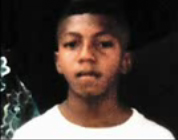 In
1995 when Patrick Obinna Okoroafor was only 14, he (according to
his brother Henry) "went to the police station because the
police wanted to inspect a car our mother had bought". He was
arrested along with six others, charged with robbery and kidnapping
— of which he says he is totally innocent. Police hung him
up, beat him, and used pliers to pull out his teeth. Exactly
two years later, in May 1997, he and the other six were sentenced
to death. Those six, including one who had been 15 at the time of
the supposed crime and was now 17 (Chidlebere Onuoha), were publicly
shot. Patrick's sentence was commuted to life. In 2001 the High
Court of Imo State ruled that the sentence of death had been "illegal,
null and void"; yet that he was "to be detained during
the pleasure of the Governor". That is, indefinitely.
In
1995 when Patrick Obinna Okoroafor was only 14, he (according to
his brother Henry) "went to the police station because the
police wanted to inspect a car our mother had bought". He was
arrested along with six others, charged with robbery and kidnapping
— of which he says he is totally innocent. Police hung him
up, beat him, and used pliers to pull out his teeth. Exactly
two years later, in May 1997, he and the other six were sentenced
to death. Those six, including one who had been 15 at the time of
the supposed crime and was now 17 (Chidlebere Onuoha), were publicly
shot. Patrick's sentence was commuted to life. In 2001 the High
Court of Imo State ruled that the sentence of death had been "illegal,
null and void"; yet that he was "to be detained during
the pleasure of the Governor". That is, indefinitely.